A nursing clipboard is the surface your entire shift lives on. Report sheet, brain sheet, vitals, med times, the three things you scribbled at handover and cannot lose — all of it rides on that board for twelve hours. Which is why the gap between a $3 school clipboard and a purpose-built nursing one is much wider than the price difference suggests.
There are really only three decisions: does it fold, does it store, and does it have reference information printed on it.
Foldable, because scrub pockets are the actual constraint
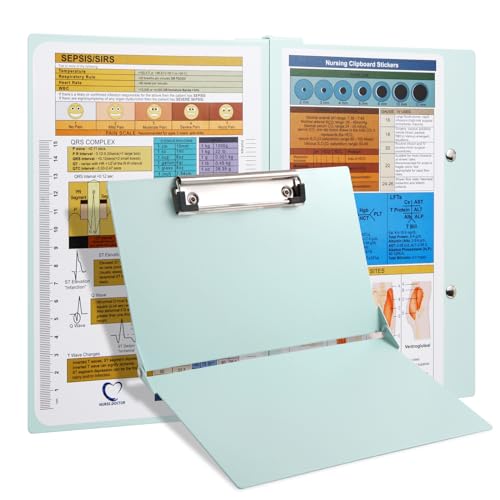
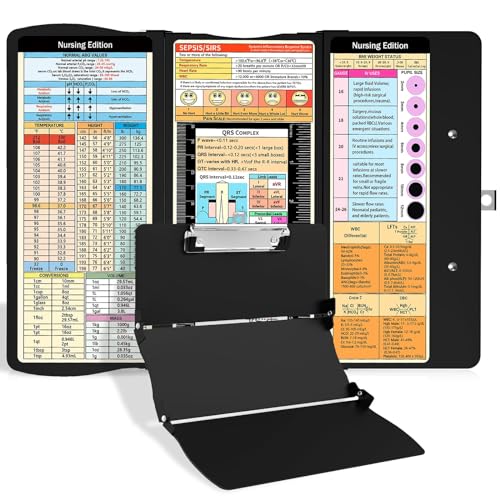
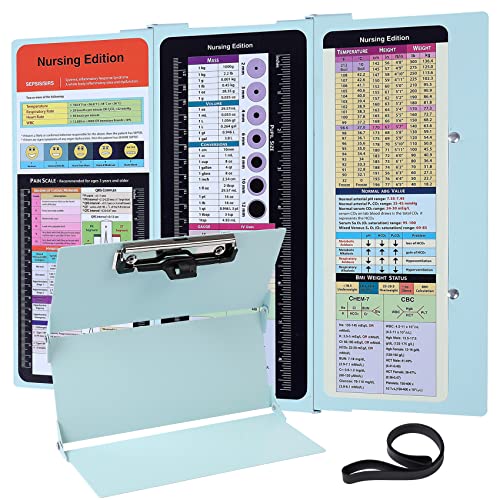
The single feature that separates a nursing clipboard from a regular one is that it folds in half to fit a scrub pocket. A full-size board has to be carried, set down, and picked up again — and the moment you set it down in a patient room you have either left protected information out or you are walking back for it.
The foldable pocket-size boards solve that. They live in a pocket between rooms and open flat when you need to write. If you are buying one thing off this page, buy a foldable one.
Printed reference data is the part people underrate
The better foldable boards have reference tables printed directly onto the board — normal lab values, vital sign ranges by age, common conversions, EKG rhythm basics, and drip-rate formulas.
This matters more than it sounds. Recalling a potassium range with confidence at 3am in hour eleven is a different task from recalling it in a classroom. Nurses look these up several times a shift, and having them on the board is faster than a phone and considerably more professional at the bedside than searching for one.
For nursing students and new grads this is the most practical item in the entire category. Clinical rotations are a continuous stream of values you have not memorised yet, and a card on your own board removes both the delay and the awkwardness of asking a preceptor.
Storage clipboards: privacy, not just capacity
A storage clipboard has a compartment beneath the writing surface. The obvious benefit is holding report printouts, spare forms, and a pen. The less obvious and more important one is privacy: a printed patient sheet folded into a scrub pocket is visible to anyone who glances at you, while the same sheet inside a closed board is not.
The Sooez and Tribe RN storage boards are the common picks here. They are bulkier than a foldable and do not fit a pocket, so they suit nurses who carry their board rather than pocket it — charge nurses, case managers, anyone doing rounds with paperwork.
Padfolios for anyone working out of a bag
The zip-pouch padfolio versions go further again, holding pens, shears, sticky notes, and a phone alongside the writing surface. That is closer to a portable desk than a clipboard, and it suits a specific set of roles: home health, community nursing, school nursing, and anyone moving between sites rather than between rooms.
If you work at one bedside on one unit, skip these — the bulk is not worth it.
What to actually buy
- Nursing student or new grad: foldable pocket-size with printed cheat sheets. Highest usefulness per dollar on this page, and it gets used from day one of clinicals.
- Floor nurse, med-surg or telemetry: foldable with reference data. The pocket fit is the deciding factor.
- Charge nurse, case manager, rounds: storage clipboard. The compartment earns its bulk.
- Home health, community, school nurse: padfolio with a zip pouch.
- Buying as a gift and unsure: foldable with cheat sheets. It is the version nobody regrets, and it pairs naturally with a badge reel and a set of reference cards for a first-job bundle.
One practical note if you are gifting: clipboards are consumables on a long enough timeline. They get left in rooms, cracked, and written on. That makes a mid-priced board a better gift than an expensive one, and a spare a genuinely welcome addition rather than a redundant one.